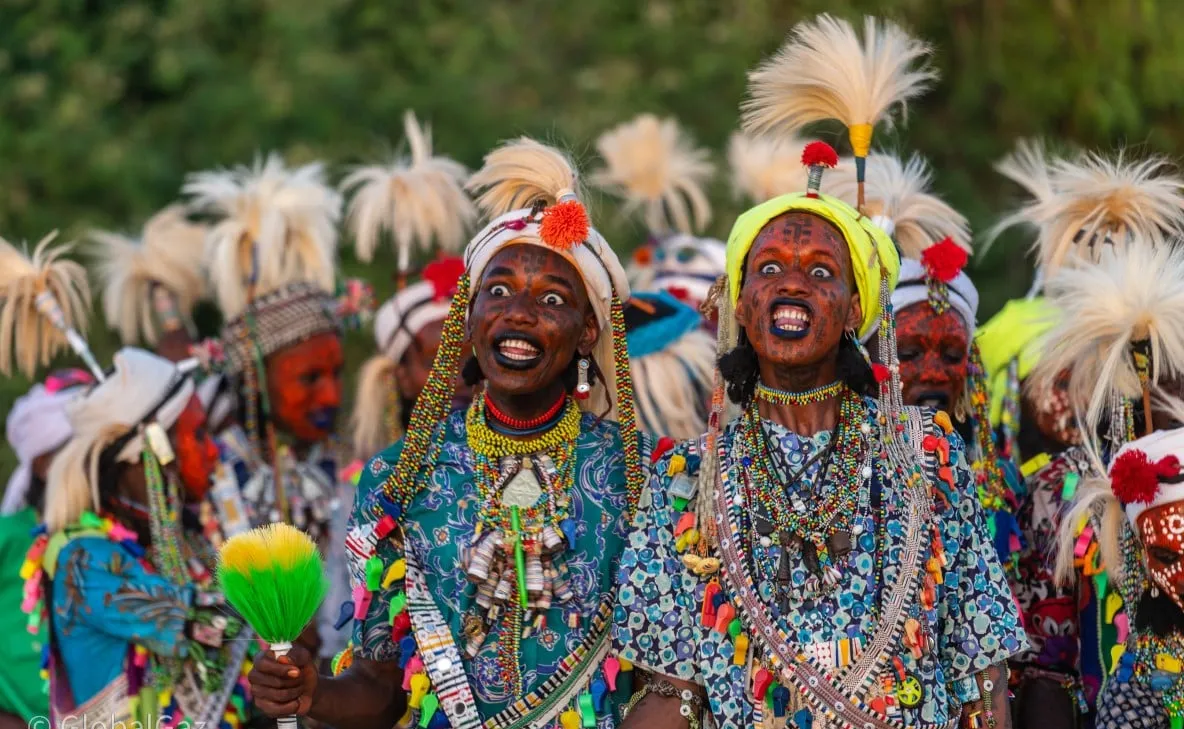
T
he Sahelian dust doesn't settle; it hangs in the air like a permanent amber filter, catching the harsh light of the Chadian savannah. In the heart of this clearing, miles away from any established infrastructure, the true meaning of human identity unfolds. This is not a performance orchestrated for cameras. This is the Gerewol—a brutal, beautiful, and hyper-competitive gathering of the nomadic Mbororo (Wodaabe) people.
The Paradox of Power and Grace
For days, lines of young men stand shoulder-to-shoulder under a blinding sun. Their faces are painted with meticulous care: bright orange clay bases derived from crushed stones, geometric white dots meant to break the symmetry of the face, and dark kohl lining the lips and eyes to accentuate the brightness of their teeth and sclera. To an outsider, it looks like theater. To the Wodaabe, it is survival. Beauty is a serious, codified metric of tribal status.
"Standard travel packages sell comfort; we sell truth. Standing in the middle of a preparation camp, watching a man spend four hours perfecting a single white line down his nose, you understand that time means something completely different out here."
Decoding the Yaake Dance
What we observe during the Yaake dance is a complex non-verbal language. The dancers do not move erratically; they vibrate. They shift weight from foot to foot, stretching their bodies upward to emphasize their height. The facial expressions—the wide-open eyes, the baring of teeth, the rolling of a single eyeball—are precise demonstrations of Charm (Togu) and endurance.
They are being judged. Group of selected young women will slowly approach the line, looking for the most charismatic dancer. The tension is palpable. No words are exchanged, only intense glances that cut through the dust. It is a raw reminder that deep cultural immersion requires patience—you cannot rush an ancient social code that operates completely outside the boundaries of western modern tourism.